Our own product · Built in-house
An instrument, not an opinion.
A scoring engine that reads a website the way an AI assistant does, a published newspaper of city editions, and a paid report with the fix plan. Live since July 2026.
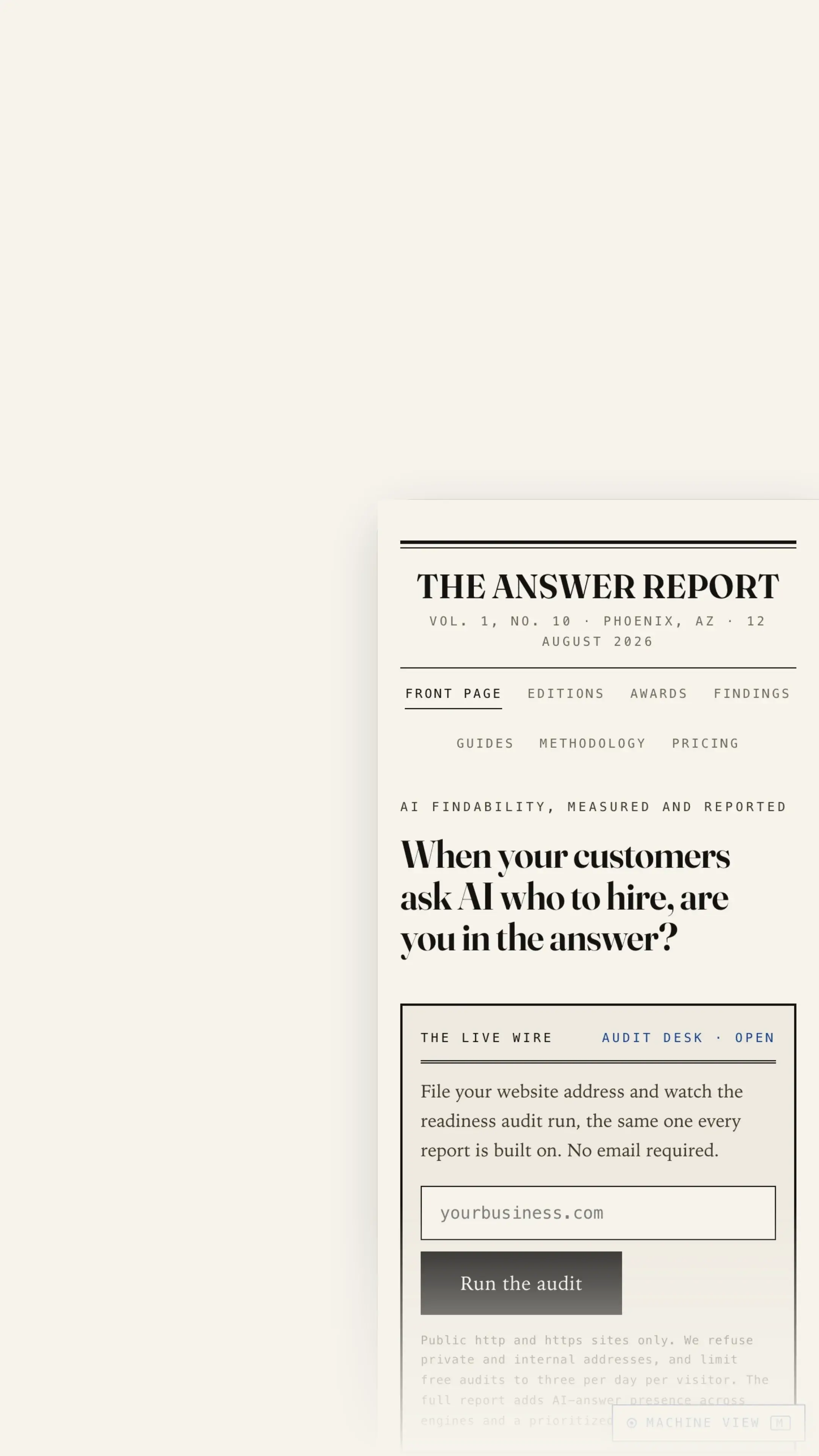
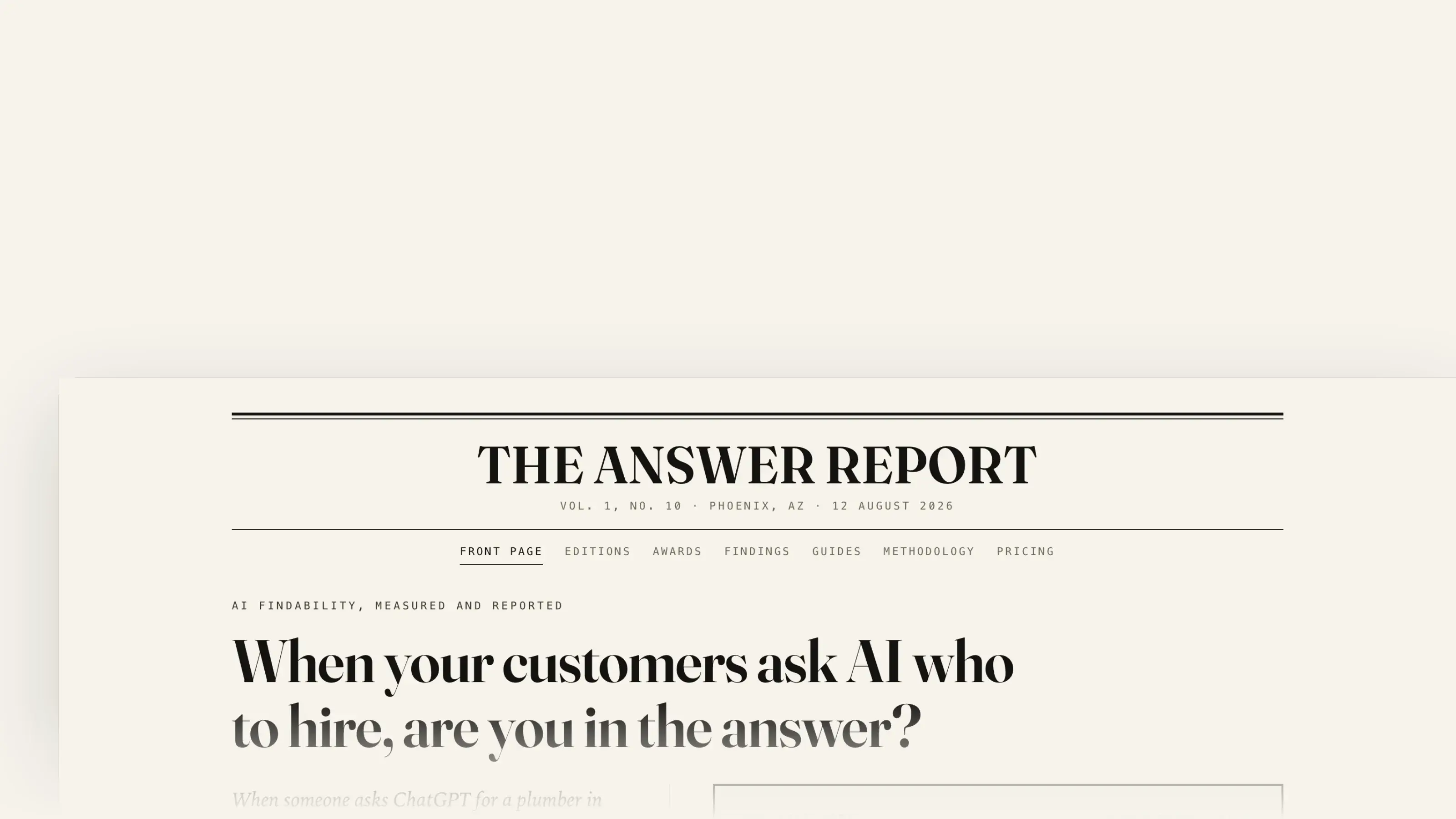
The Answer Report measures how well an AI assistant can read a business website, publishes the score, and sells the fix.
More and more people ask an assistant who to hire before they open a search box. We measured what that means. Between 17 and 30 July 2026 we asked two AI engines the questions engaged couples ask, in three American cities: 153 of the 173 local wedding businesses we tracked were never named in any answer. In the Dutch province of Utrecht we asked 840 times for an installer, and none of the 70 businesses we tracked appeared in a single answer. So we built the instrument. A deterministic engine scores a site from 0 to 100 on what an assistant actually reads, a newspaper publishes those scores one city edition at a time, and a paid report turns the score into a step plan a web developer can work through. Ten editions are out, the engine grades our own sites in public, and since 4 September 2026 the same engine runs a €99 website audit for Dutch businesses.
Specs
Product design, scoring engine, editorial design, automation
Measure, publish, fix, re-check
Small business, US and the Netherlands
July 2026, live
Context
The Challenge
A product that grades other people has to be unarguable, so almost every decision here is a decision about trust.
A number nobody can argue with.
A score is worthless if two runs disagree. Every check is fixed, the pages sampled are chosen by a stable rule, and each finding quotes the exact page text behind it. The same site scored on two different days returns the same number.
It has to pass its own test.
A product about being readable by machines cannot itself be unreadable by machines. It publishes its own score from the same engine, 93 out of 100, and prints why it is not 100.
Strangers get to run it.
The audit is open to anyone, with no email and no account. That is an open door into a machine that costs money to run, so the door was built with limits: public addresses only, three free audits a day per visitor, one job at a time.
A score is not yet a report.
A ranked list of findings is a draft. An owner pays for the story in their own terms and a plan their developer can execute. Before the first Dutch report went out, four were written by hand against real sites, and all four differed from the machine's draft. The engine had to learn from that first.
Execution
The Solution
One product in three layers: the engine that measures, the publication that carries it, and the rails that run both.
Roadmap
What it does now
The engine grades our own work in public, and the numbers have started doing the arguing.
Currently Optimizing
It publishes its own score
The engine gives theanswerreport.com 93 out of 100. The missing points are a phone number the publication does not have. Rather than invent one, the correction is printed on the front page.
It changed how we build websites
The first self-demonstration took vonzie.studio from 60 to 93 in July 2026: a hosting-layer default had been silently blocking AI crawlers and hiding the contact address. In the fleet sweep of 31 July, 26 live sites averaged 74.2 against 72.3 for the 182 businesses we were emailing about the same problem, and vonzie.studio went to 100 that day. Since then no site leaves the studio unmeasured.
A Dutch example anyone can read
The public example at audit.vonzie.studio/voorbeeld is a real audit with the identifying details replaced, not an invented business: score 61, twelve findings, measured on 4 September 2026. The business was not asked and is not named, which is exactly why it is anonymised.
The Backlog
A city at a time
Adding an edition is a data step, not a development step, so the publication grows by cities. The rung above the €99 report is the fix work itself, at a fixed price per item.
"We wanted an instrument, not an opinion. If a score is going to cost someone money to fix, it has to come out the same every time and it has to show its evidence, starting with our own."
Vonzie Studio