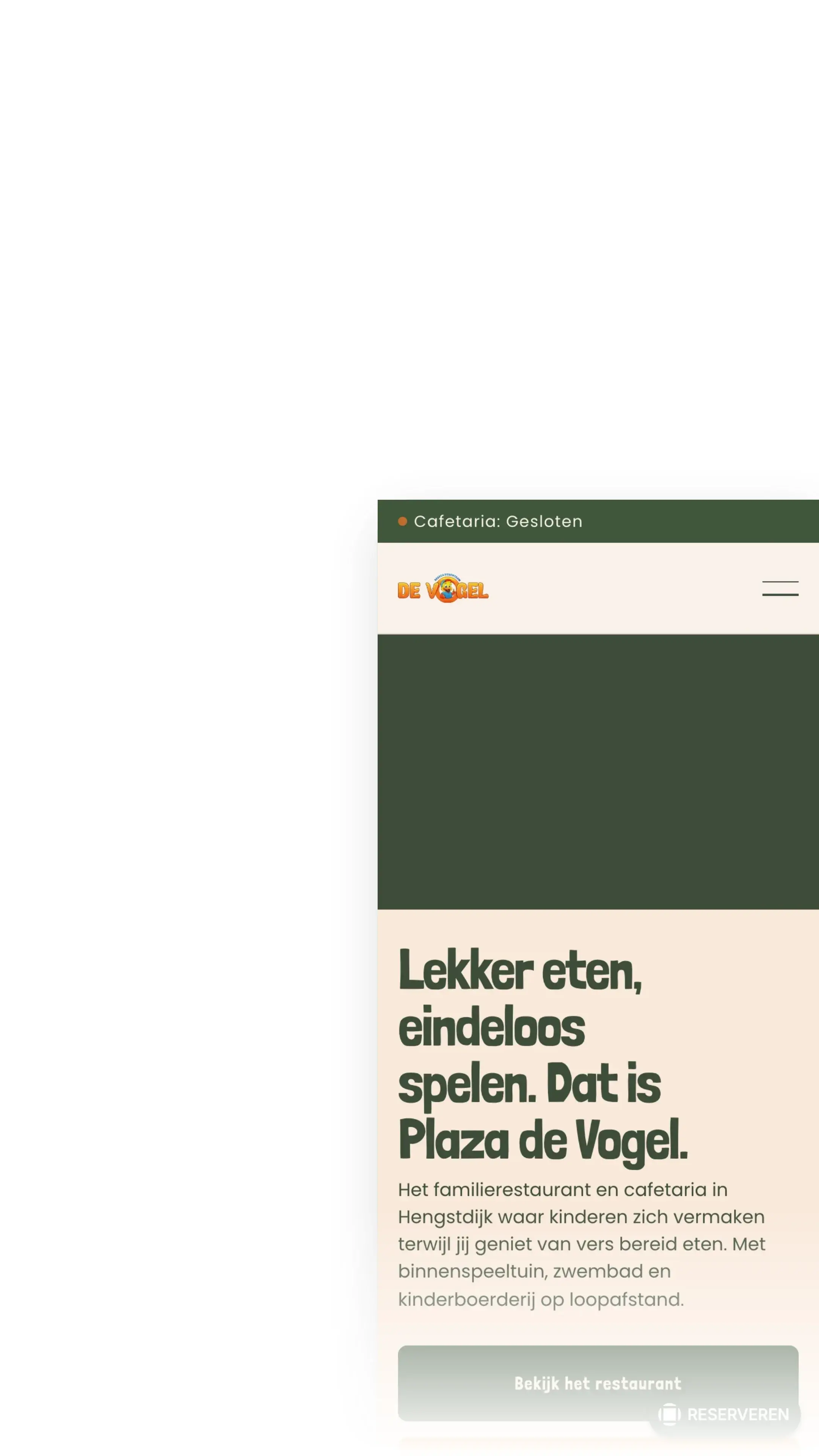
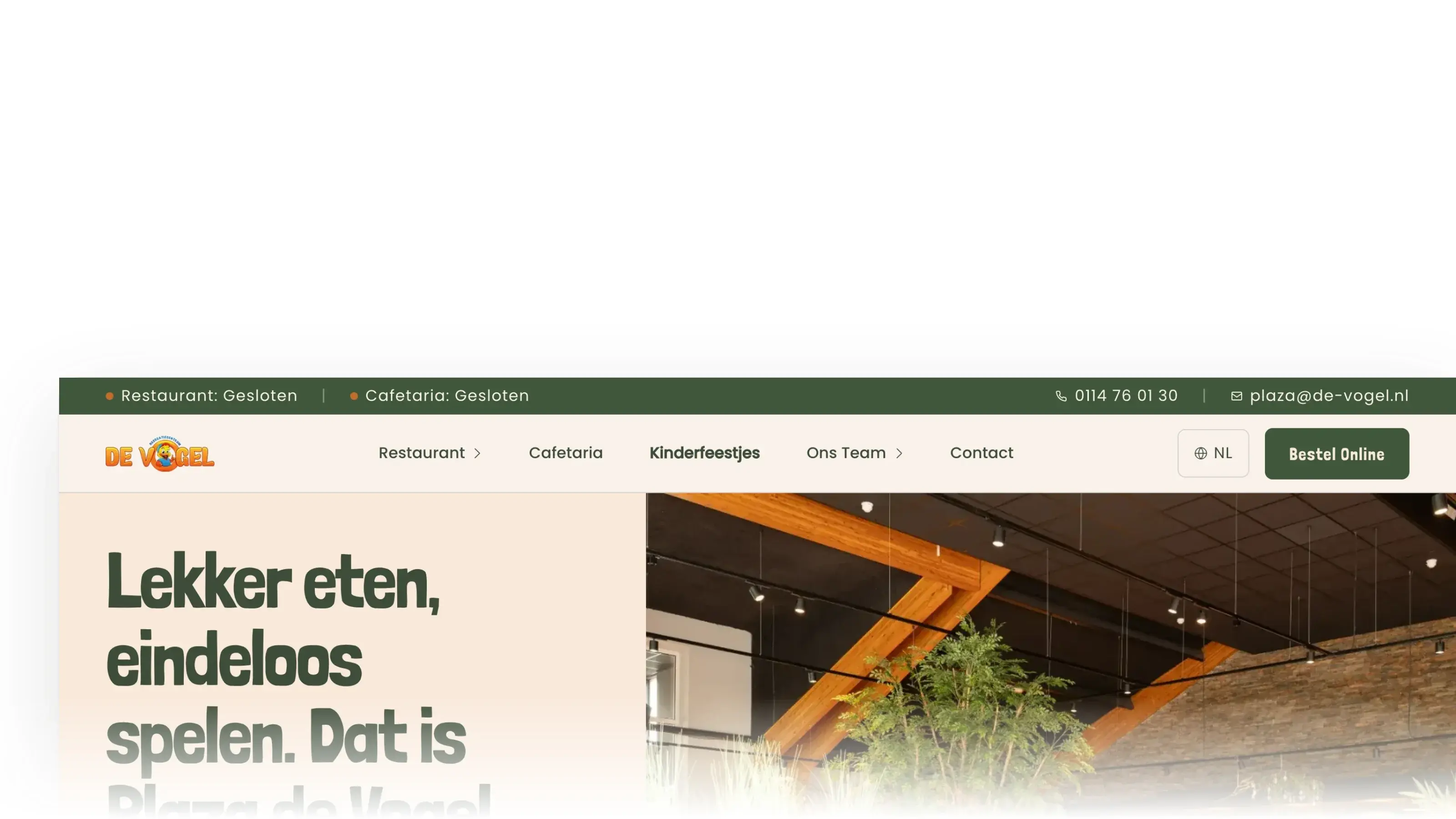
Family restaurant & cafetaria · Hengstdijk, NL
Same site. Now in code.
Our 2025 site for the venue, moved page for page off a rented page builder into code, in three languages, with four forms that reach the inbox.
Plaza de Vogel already had the site it wanted. We had designed it. The job was to move it, page for page, off a rented page builder and into code.
Plaza de Vogel is the family restaurant and cafetaria on recreation park De Vogel in Hengstdijk, near Hulst: a restaurant, a cafetaria and an indoor playground under one roof, with the covered pool and the petting zoo a few steps away. The site has spoken Dutch, English and German since its first version. In 2025 we designed and built that site on a page builder. In spring 2026 we rebuilt it as code: the same seventeen pages, the same three languages, one content system for the menu and the hours, and four forms that mail the venue directly. Nothing for the team or the guests to relearn. What changed sits underneath: the site no longer depends on a builder subscription, and its findability, its forms and its content are ours to keep in order.
Specs
Design (2025), the move into code, content system, forms, findability
Dutch, English, German
17 pages, 51 addresses, 4 forms
2025 to 2026, in care
Context
What had to hold
A page-for-page move has one rule: the visitor notices nothing, and the venue gains everything underneath.
Nothing to relearn.
The venue and its guests knew the site. Every page, every menu line and every button had to land in the same place, or the move would cost the team the familiarity it had already paid for.
Three languages, one truth.
Dutch, English and German had to stay complete after the move. A dish renamed in Dutch has to change in English and German too, without three separate edits.
A menu that changes by season.
Seventy-five dishes in eight categories, plus party packages, opening hours per venue and vacancies. The venue changes them, and a change must never wait for a developer.
Forms that actually arrive.
A kids-party booking or a group quote is real money for the venue. A form that thanks the visitor while the message never left is worse than no form at all.
Execution
What we did
Nine days to port every page, then a season of care: languages, content, forms, findability.
Roadmap
In care
A live site is work that continues. Three things run, one is planned.
Currently Optimizing
Forms watched
Every send passes through one door that checks the mail service's answer. A refused message answers with an error, never with a thank-you page for mail that never left.
Findability held at 100
Any change to what assistants and search engines read from the site is followed by a re-audit against the live address, with the score and the date recorded.
Content edits on request
Menu, hours, packages and vacancies change in the content system. The June 2026 round restructured the navigation, split food from drinks and added the hours page.
The Backlog
A first measured season
Analytics run behind consent, so clicks to reserve and to order are counted honestly. The next round gets planned from a full season of those numbers, not from guesses.
"We designed their first site, so we knew every corner of it. Moving it into code changed nothing the guests see and everything underneath: three languages we keep whole, a menu the team changes in one place, and forms that land where they should."
Vonzie Studio